Paperless HACCP: How Small Food Businesses Use AI-Guided Checklists to Stay Audit-Ready
Your HACCP plan sits in a binder. Your team doesn't read it. Here's how UK cafés and restaurants turn paper procedures into daily execution that actually passes FSA inspections.
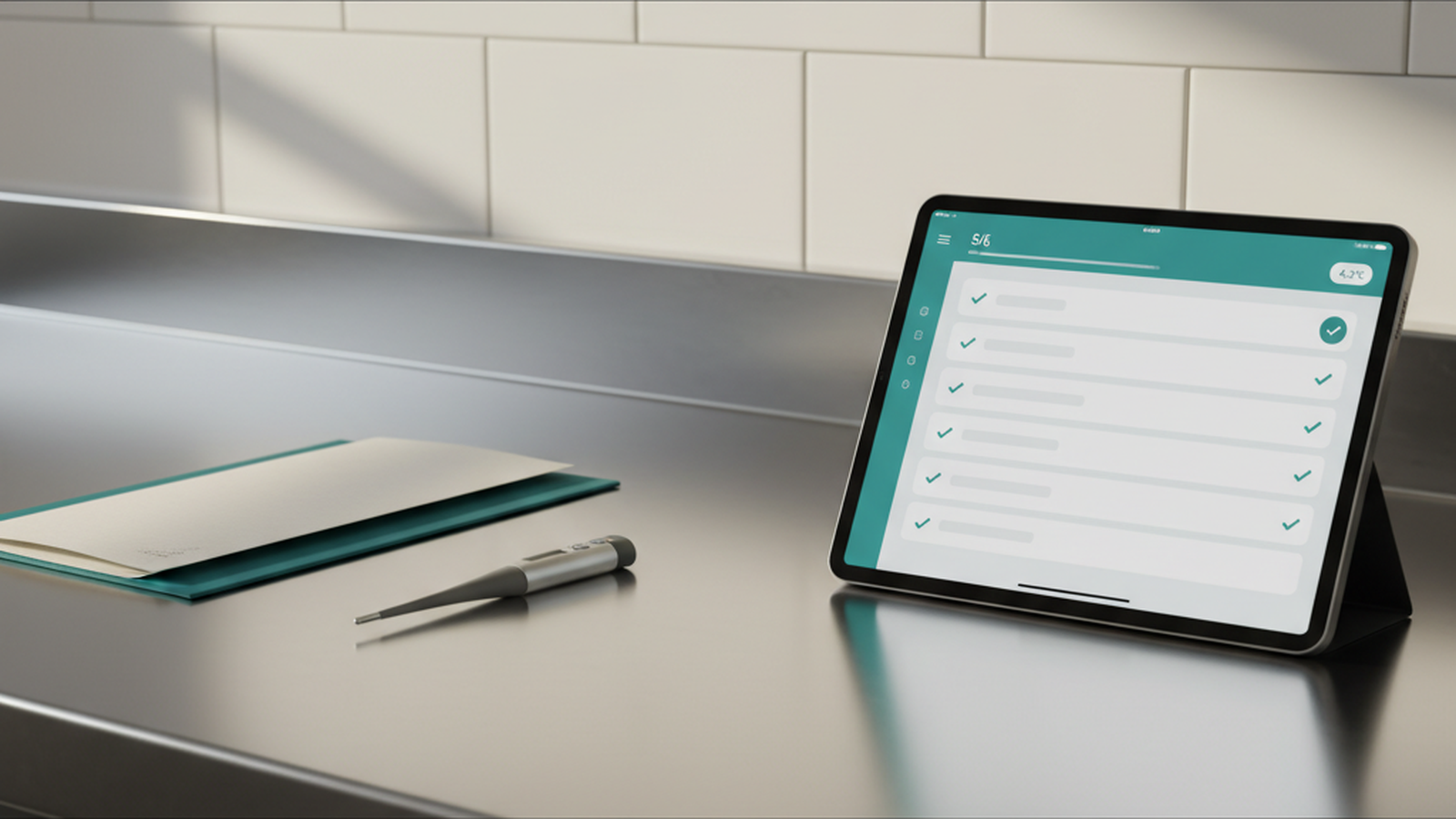
It's 8 a.m. on a Tuesday. The FSA inspector wants your cold-storage temperature log, last 30 days. Your night-shift lead has been initialing the paper sheet without actually checking the thermometer. You don't know that yet. Three pages in, the inspector spots two consecutive entries with identical readings to one decimal place, recorded on a day the cafe was closed for a bank holiday. That's enough.
The next 30 minutes get expensive. Not because your HACCP plan is wrong. Because nobody actually executed it.
You have the plan. The plan isn't the problem.
If you run a UK café, restaurant, or small food business, you almost certainly have a HACCP plan. You wrote it yourself off an FSA template, or paid a consultant £400-£1,200 to build one. It documents your hazard analysis, your critical control points, your monitoring procedures, your corrective actions. It complies with retained EU Regulation 852/2004 and FSA guidance. It sits in a binder in the office.
It does not save you at inspection.
What saves you is what your team does at 6:30 a.m., 11:00 a.m., and 10:00 p.m., every day, on shift. And in most small food businesses, here's what actually happens:
- The morning lead opens up at 6:30, has six things to do before the first customer.
- Temperature checks on three fridges. Glance, "looks cold", initial the sheet.
- End of shift, fills in the gaps with plausible numbers.
- Friday, the inspector spots a Tuesday entry that doesn't match the data logger on the cold-room compressor.
- Form 1, observation 1.
The gap between a working HACCP system and one that costs you a hygiene rating drop isn't the quality of your written plan. It's daily execution.
What "executable" actually means
An executable HACCP system has three properties paper can't deliver:
1. Operators don't have to read the plan. The system tells them what to do, exactly when to do it, without searching. At 6:30, their phone shows: "Check fridge 2 (limit: 5°C max). Enter the reading shown on the thermometer." That's the whole interaction.
2. Records are entered at the moment of action. Not at the end of shift. Not the next morning. If a temperature check isn't entered when scheduled, the system flags it as missing. That's the difference between evidence and reconstruction.
3. The audit trail exists regardless of who's running the shift. Who checked, when, what value, from which device, at which location. The inspector can't say "this was filled in retroactively" because the timestamps are independently verifiable.
None of this requires changing your HACCP plan. The plan stays the same. What changes is how it gets executed.
Four steps to make a paper HACCP plan paperless
You don't need a new consultant. You don't need to throw out the binder. The work is mechanical.
Step 1: List the daily critical points
Pull your existing HACCP plan and list everything that needs checking daily or more often. For a typical UK café:
- Fridge and freezer temperatures (3-6 units, twice daily)
- Hot-hold temperatures for pre-prepared food (every 2 hours during service)
- Wash temperatures at the dishwasher (start of service, after deep clean)
- Surface cleaning after each shift change
- Goods-in checks for date and temperature (every delivery)
- Personal hygiene at start of shift
Most small food businesses have 6-12 such points. Not hundreds.
Step 2: Turn each point into a discrete action
Each critical point becomes a single, unambiguous question with a clear answer. Instead of "monitor the fridges", the digital step looks like:
Display fridge, milk and dairy (limit: 5°C max) Enter the reading shown on the thermometer.
If the value is over the limit, the system asks immediately what corrective action was taken (called the engineer? moved the stock? discarded?) and logs the action.
Step 3: Assign frequency and shift order
Group the steps by shift. What gets done at open, mid-service, close, weekly. The system delivers each shift's checklist in the right order at the right moment.
Open at 6:30: 8 steps. Mid-service check at 11:00: 3 steps. Close at 22:00: 7 steps. Weekly deep-clean Sunday: 12 steps.
Step 4: Make the audit trail automatic
Every action logs itself: who, when, what value, from which device. When the FSA inspector asks for the last 30 days of cold-storage records, you export a PDF in seconds, with timestamps that match your point-of-sale data and CCTV. If steps were missed, they show as missed. That's better for you long-term, because you can see where the system is breaking down and fix it before the inspector does.
What this actually looks like in Sopia
Here's the part most "go digital" articles skip: what it actually takes to turn the binder into procedures your team runs.
Setup (one-time, ~30 minutes for a small café):
You or your manager open Sopia, click "Create procedure", and enter two things:
- Title: "Cold storage temperature check, open shift"
- Description: paste or paraphrase the relevant section from your HACCP plan. For example: "3 fridges to check at open, display fridge milk and dairy (5°C max), walk-in chiller (5°C max), freezer (-18°C max). If reading is over the limit: move stock to a working unit, call the engineer, log the non-conformance and corrective action. Check at 6:30 a.m., signed by the morning lead."
Click Generate. Sopia's AI (running on Claude) returns:
- The written SOP (200-500 words, properly formatted: context, responsibilities, step-by-step actions, corrective actions)
- An actionable checklist (5-15 steps, each starting with a verb, each verifiable): "1. Check the thermometer on the milk and dairy fridge. 2. Enter the reading. 3. If over 5°C, move stock and call the engineer. ..."
You edit anything that needs adjusting, you save. Repeat for each critical control point in your HACCP plan: dishwasher temperature, hot-hold checks, goods-in, cleaning logs, personal hygiene. A typical café ends up with 6-12 procedures. Total setup time: one afternoon, not a project.
Daily execution (the operator, on a phone):
Next morning at 6:30, your morning lead opens the app. They see which procedures are due for the shift. Open the first, work through the checklist, tick each step as they go. When they enter a reading, it's saved with a real timestamp.
If something unexpected comes up (broken thermometer, an unfamiliar reading, a step that's unclear), they tap the chat icon next to the step. Sopia's AI replies using your specific SOP and the current step as context, not generic advice. If your SOP says "call engineer X on number Y", that's what the AI tells them.
At the end of shift, they sign digitally. What was done and what was missed is logged automatically.
For you, the owner:
Weekly dashboard: which procedures ran, which had missed steps, where patterns are forming ("evening lead misses temperature checks three times a week"). When the FSA inspector arrives, you export the HACCP record for the requested period in 10 seconds.
It doesn't replace your HACCP plan. It makes the plan execute itself, without turning you into the person who chases people for paperwork.
What FSA inspectors actually check
UK FSA inspectors look at three things, weighted by what changes your hygiene rating:
- Hygiene of food handling and food storage (your daily monitoring records). This is where most rating drops happen.
- Cleanliness and condition of facilities (visual inspection on the day).
- Confidence in management (the food safety management system, including HACCP, training records, and corrective action evidence).
A digital execution layer hits all three. Records become verifiable rather than reconstructed. The visual side gets easier because operators are doing scheduled cleaning checks rather than relying on memory. And confidence in management goes up the moment the inspector sees that the records were entered live, with corrective actions logged at the time the issue happened.
A 5-rated café isn't one that has a perfect plan. It's one that proves the plan runs every day.
What to do this week
- Pull your HACCP plan out of the binder. List every check that has to happen daily or more often.
- Group the checks by shift: open, mid-service, close.
- For each check, write the limit and the corrective action in one line. If you can't, that's the gap.
- Try running one shift with a digital checklist instead of the paper sheet. Even a shared note on a phone will show you where the friction is.
Want to see what a paperless HACCP system looks like for your business? Try Sopia free for 14 days or book a 30-minute demo.